




AARP Hearing Center





















































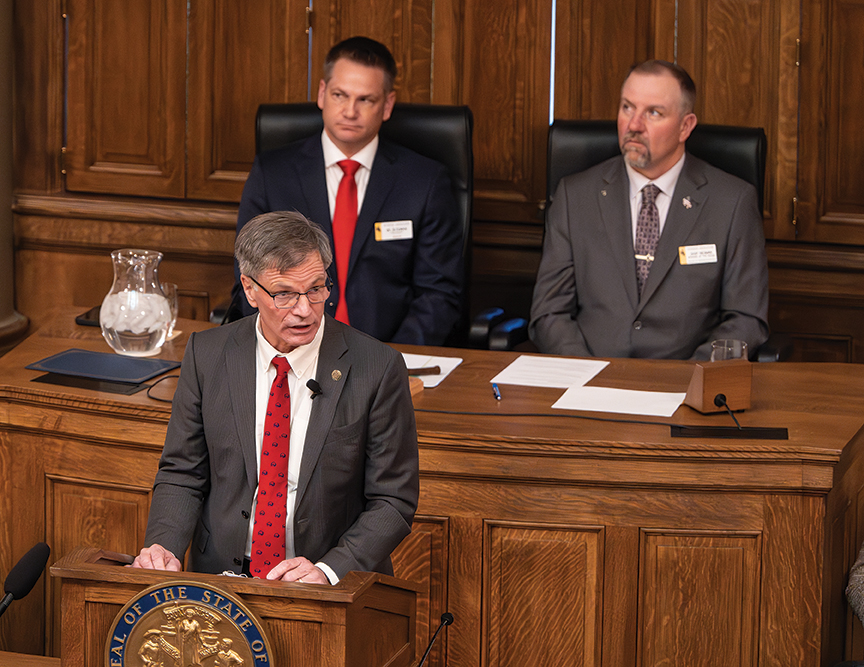
Photo by Michael Smith for AARP Wyoming
“It’s all about the budget.”
That is the common refrain of governmental relations professionals every other year in Wyoming. The 2026 legislative session will see Wyoming lawmakers take Governor Mark Gordon’s proposed two-year budget and pare it down to something that can pass both chambers of the Legislature. That could be a tall order, given that the Legislature could not pass a supplemental budget in 2025.
The session begins in Cheyenne on Feb. 9.
Rep. John Bear (R-Campbell) chairs the Joint Appropriations Committee (JAC) with Senator Tim Salazar (R-Fremont) and said he was surprised that the body wasn’t able to pass a supplemental budget last year.
“I have less fear that it would happen again this year,” Bear told AARP Wyoming regarding the failed supplemental budget effort in 2025. “I didn’t see it coming. I was caught off guard that we didn’t have a budget. That decision was made by three senators. I think if you go back, we got a product (budget) out of JAC, then went to the floor for three readings in both chambers. The news articles would tell you the Freedom Caucus cut out a lot of the governor’s budget, and the Senate put a lot of it back in. My anticipation was that we could find some middle ground and send it back to the governor.
“I was pretty proud of the JAC product, to be honest.”
Despite last year’s result, Bear says he is more optimistic that a budget will go to the governor this year. He points out that a budget is a constitutional requirement, and failing to produce one would be disastrous. Bear adds that he has been working to create stronger relationships with his Senate colleagues, especially co-chair Salazar, which he hopes will benefit him when it comes to negotiating a biennial budget in 2026. For his part, Salazar also feels confident that the Legislature will get a budget passed in 2026.
“We will have a biennial budget in 2026,” Salazar says. “We have to. It is constitutionally required. I’m confident we will come together to craft a budget that will pass both chambers.”
Bear’s co-chair on the Senate side, Salazar says citizens should expect a responsible, conservative budget that maximizes every dollar the state spends without wasting money. He adds that he finds it a priority to protect home services for older adults.
“We will work to keep property taxes low and reduce inflation and will work to help Wyomingites with affordability in all areas in the face of rising costs,” Salazar says.
Bear says his focus is on funding the most fundamental and expected government responsibilities that the public expects. He adds he expects more money to be spent on wildfire fighting. He believes there is still work to be done on property tax relief, which should be accompanied by a corresponding reduction in expenditure. Despite recent strong reports on state investment income, Bear says now is actually the time to consider cuts to the state budget. He recently announced efforts by the Freedom Caucus to champion cuts to state spending, aiming to return to pre-COVID funding levels. That means a budget similar to the one for 2019-2020. He notes that the COVID era was a pivotal time for a surge in property evaluations, citing an 11% increase in assessments, yet a 3.6% increase in household incomes in the state.
“We saw phenomenal income from our investment,” Bear says. “We added $3 billion to our savings account, yet at the household kitchen table, people are not seeing their own household savings account rise by 10%, but we are seeing it in the government.”
The Legislature will consider several measures sponsored by the Joint Revenue Committee to continue the discussion on property tax relief. Among those ideas are transitioning the state to a cost-of-acquisition system, in which homeowners are taxed based on the price they paid for their house; making the Property Tax Exemption for Long-Term Homeowners permanent; and exploring ways to combine the sales and use tax codes with the property tax codes. Members of the Revenue Committee have suggested that the state shift its reliance from property taxes to sales and use taxes. Thus far, specific proposals for doing so have not been fleshed out.
Bear said the committee is working to educate itself, as several of the members are still relatively new to the appropriations process. On that front, he says a subcommittee is conducting a thorough examination of the Wyoming Department of Health’s budget, analyzing where it is spent and who it serves. Bear tells AARP Wyoming he doesn’t expect major changes to programs that impact older adults. He referenced Department of Health cuts that impacted long-term care services in 2017 and 2021, prior to the Legislature’s vote to restore funding to home and community-based services, and stated that similar cuts should not be expected in this budget.
“We see (home health services) as a savings to the government,” Bear says. “If someone has to go into a nursing home, it is much more expensive. Your constituency should see this issue treated differently than in the past when the government has been constrained.”
AARP Wyoming’s wishlist on budget topics includes money for guardianship service through Wyoming Guardianship Corporation, some emergency funding for our state’s aging next-generation 9-1-1 system, and a look at ways to keep ambulance service available for Cowboy State residents.
For years, there has been little doubt that your local EMTs would be there for you; however, the reality is that Wyoming has seen 16 Emergency Medical Service agencies close up shop or consolidate with another service over the past decade. The Legislature’s Labor, Health, and Social Services Committee listened to concerns of advocates, including AARP Wyoming, during its June 23 meeting and, in October, chose to sponsor a bill that would increase the Medicaid rate for claims made by ambulance companies. This measure, along with the accompanying $1.3 million appropriation, had broad support among the committee, although it received a “no” vote from committee co-chair and Freedom Caucus House Leader Rachel Rodriguez-Williams, which may signal opposition from the Freedom Caucus during the session.
While an additional $1.3 million is far from a silver bullet for saving our state’s struggling ambulances, it will help replenish the system of a service that Wyomingites are very supportive of. An AARP Wyoming survey from 2024 found that eight out of ten of the 1,003 adults contacted by AARP Wyoming felt that EMS should be an essential service, and 83% said they would be willing to pay at least $5 per year to support ambulance service in their area.
While the budget won’t be easy, Bear thinks interpersonal work among the committee itself will make the 2026 process a little easier.
“Relationships are how you make these things work,” Bear says. “Because of that, I have a higher level of confidence that we can work something out in a budget. The governor would love to see us fail and call us back into special session, and I know there are a lot of people who will work hard not to have that happen.”
About AARP Wyoming
Contact information and more from your state office. Learn what we are doing to champion social change and help you live your best life.